
Home Carbon Footprint: The 5 Changes With the Biggest Payoff in Northern Colorado
Lower bills. More comfort. Smaller footprint. No guilt required. Northern Colorado’s “surprise weather” (wind, cold snaps, warm spells, smoke days) makes home energy use swing hard—especially if you heat with natural gas or have older insulation. The fastest way to cut your home carbon footprint and protect your budget is to focus on the upgrades that reduce the most wasted energy first. Here are the five highest-payoff moves for most homes in Fort Collins / Loveland / Windsor / Greeley and nearby areas, in the order that typically delivers the best mix of comfort, savings, and emissions reduction.
SAVING MONEYCARBON FOOTPRINTGREEN LIVING
Air seal + insulate the “leak points”
Why it’s a big deal here: Cold winds + temperature swings punish leaky homes. If you’re heating air that immediately leaks out, you’re paying for comfort you never get
What to do (high impact, usually low drama):
Seal the obvious leaks: attic hatch, plumbing penetrations under sinks, recessed lights, rim joists, door frames, window gaps.
Add/upgrade insulation in key areas: attic first (usually the best payoff), then crawlspace/basement rim joists where accessible.
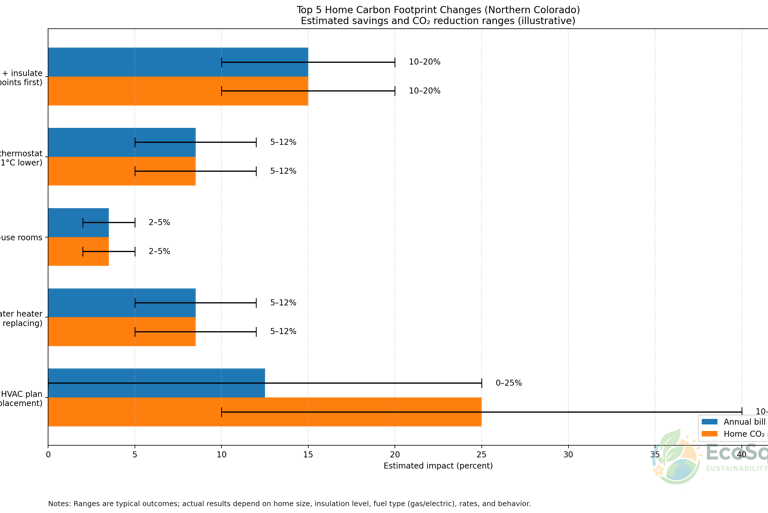
Why it saves money + carbon: Less air leakage means less furnace run-time and fewer cycles. ENERGY STAR estimates homeowners can save about 15% on heating and cooling costs by air sealing and adding insulation in common areas (attics, floors over crawl spaces, rim joists).
Get smart about temperature control
Why it’s a big deal here: Heating is often the largest home energy load in winter. Small changes matter because they apply every single day.
What to do:
If you won’t remember to adjust temps daily, install a smart thermostat and use schedules.
Try the simplest rule: turn it down a little when you’re asleep or away.
What the data says:
The IEA notes lowering your thermostat by 1°C can save ~7% of heating energy.
ENERGY STAR reports smart thermostats can save around 8% on heating and cooling bills on average (savings vary by home and habits).
Why it saves money + carbon: You’re reducing fuel burned (gas) or electricity used (electric heat), and you’ll feel fewer “why is my bill insane?” months.
Switch the lights you use most to LEDs
Why it’s a big deal here: It’s one of the cheapest, easiest upgrades with immediate results—and it keeps paying back for years.
What to do:
Replace the bulbs that are on the most (kitchen, living room, exterior lights, garage).
Prioritize the “always on” fixtures first.
What the data says: The U.S. Department of Energy says residential LEDs use at least 75% less energy and can last up to 25 times longer than incandescent lighting.
Why it saves money + carbon: Less electricity for the same light output = lower emissions from your electricity use and lower bills, with fewer bulb replacements.
When your water heater is due: choose a heat pump water heater
Why it’s a big deal here: Hot water is a year-round load—so upgrades keep paying even when the weather changes.
What to do:
If you have an older electric resistance water heater (or you’re replacing any unit soon), consider a heat pump water heater (HPWH).
Plan placement (they work best in spaces that stay roughly 40°F–90°F year-round).
What the data says: DOE notes heat pump water heaters can be 2–3 times more energy efficient than conventional electric resistance water heaters.
Why it saves money + carbon: You get the same hot water with much less energy—lower bills and less emissions, especially if your electricity is getting cleaner over time.
Make your next HVAC replacement a heat pump decision (not an emergency purchase)
Why it’s a big deal here: HVAC replacements are expensive, so you want your next system to do double duty efficiently—especially with Colorado’s hot/cold swings.
What to do:
If your AC or furnace is aging, start planning early so you’re not buying under pressure.
Consider an air-source heat pump, which provides both heating and cooling.
What the data says: ENERGY STAR explains that air-source heat pumps deliver efficient heating and cooling by moving heat (instead of creating it through combustion), and their fact sheet notes they can deliver up to three times more heat energy than the electrical energy they consume (conditions vary).
Why it saves money + carbon: Heat pumps can reduce fossil fuel use for heating and often cut cooling costs too—plus your home is ready for future incentives and cleaner electricity.
The Northern Colorado “best order” (if you want a simple plan)
Air sealing + attic insulation (biggest comfort upgrade)
Thermostat strategy / smart thermostat (biggest behavior payoff)
LEDs (easy wins, fast payback)
Heat pump water heater when replacing (year-round savings)
Heat pump HVAC when replacing (big system payoff)
How EcoSquad can help (so this doesn’t turn into a research project)
EcoSquad can help you:
identify your top leaks and insulation priorities
build a “do this first” upgrade path based on payoff
recommend product choices that fit Northern Colorado weather
help you avoid expensive upgrades that don’t move the needle
If you tell us whether you’re in a house, townhouse, or apartment (and whether you heat with gas or electric), We can tailor this into a super practical “next 30 days” checklist.
CitationS
DOE — LED Lighting (75% less energy; up to 25x longer): https://www.energy.gov/energysaver/led-lighting
DOE — Air Sealing Your Home (air leaks cut heating/cooling; quick ROI): https://www.energy.gov/energysaver/air-sealing-your-home
DOE — Insulation (reduces heat flow; lowers heating/cooling costs): https://www.energy.gov/energysaver/insulation
ENERGY STAR — Seal & Insulate Savings Methodology (avg ~15% heating/cooling savings): https://www.energystar.gov/saveathome/seal_insulate/methodology
IEA — Saving Energy (1°C thermostat reduction saves ~7% heating energy): https://www.iea.org/topics/saving-energy
ENERGY STAR — Smart Thermostat FAQ (avg ~8% heating/cooling bill savings): https://www.energystar.gov/products/heating_cooling/smart_thermostats/smart_thermostat_faq
DOE — Heat Pump Water Heaters (2–3x more efficient than electric resistance): https://www.energy.gov/energysaver/heat-pump-water-heaters
ENERGY STAR — Air-Source Heat Pumps (efficient heating/cooling): https://www.energystar.gov/products/air_source_heat_pumps
ENERGY STAR — Air Source Heat Pumps Fact Sheet (moves heat; up to 3x output): https://www.energystar.gov/sites/default/files/2024-07/2024%20Air%20Source%20Heat%20Pumps%20Fact%20Sheet.pdf
EPA — Sources of Greenhouse Gas Emissions (transportation/electricity context): https://www.epa.gov/ghgemissions/sources-greenhouse-gas-emissions






Contact
Get in touch for a greener tomorrow
Phone
© 2025. All rights reserved.
Join EcoSquad
Get tips and updates for greener living.